Radiometry in industry: When conventional measurement technology reaches its limits

Fabian Fischer
Extreme process conditions are part of everyday life in many industries. High temperatures, aggressive media, high pressures or heavy buildup regularly pose major challenges for conventional measuring methods. This is precisely where radiometry comes into its own. Radiometric instrumentation enables reliable measurement where other methods fail – a technology without process contact, that is wear-free and highly robust.
In this article, you’ll learn how radiometric technology works, what advantages it offers and the applications where it is indispensable as a measurement solution.
 

What is radiometric measurement, simply explained?

Radiometry is a measuring technique that utilises the physical properties of gamma radiation as it passes through matter. Depending on the presence, density and thickness of the medium being measured, the penetration of radiation is attenuated by varying degrees. This attenuation can be precisely measured and converted into valuable process information.
A key advantage: The measurement is carried out entirely externally to the process. Measuring from outside, through a pipe or container walls, means the sensors do not come into any contact with the process medium. This makes radiometric measurement especially suitable for challenging and safety-critical applications.

How do modern radiometric measuring systems for industrial applications work?

A radiometric measuring system essentially consists of three components:

  • Radiation source
    Long-lasting, encapsulated radioactive isotopes like caesium-137 or cobalt-60 are used. They continuously emit high-energy gamma radiation. The choice of isotope depends on the application – while cesium-137 lends itself well for level and density measurement, cobalt-60, due to its higher energy, is more commonly deployed for thick-walled containers or large pipelines. 
  • Source holder
    The VEGASOURCE source holder reliably shields the source in all directions, allowing radiation to escape only along the defined beam path.
  • Detector
    The detector is the central element of radiometric measurement, because the gamma radiation emitted by the radiation source passes through the process medium and strikes a detector. VEGA employs the principle of scintillation detection, in which a so-called scintillator – usually an organic plastic material (PVT or PS) or a crystal like sodium iodide (NaI) – converts incident gamma rays into flashes of light (scintillations). These light signals are then detected by a photomultiplier (PMT), amplified and converted into electrical pulses. These pulses are counted, which is why the term “counting tube principle” is used. The more radiation strikes the detector, the more pulses are generated.

Conversely: The denser or thicker the material being penetrated, the more the radiation is attenuated and the lower the count rate measured at the detector. This inverse relationship allows parameters such as level, density, limit level, interfaces or mass flow to be determined with precision. The hihgly capable integrated signal conditioning in the electronics of VEGA sensors convert these counted pulses into a measured value. Thanks to their robust design and high sensitivity, VEGA’s scintillation detectors are regarded as the standard for demanding applications. They are available in various designs and lengths for use in hazardous areas as well as for complex container geometries and large measuring ranges.


Advantages of radiometric measurement

Radiometry is one of the most reliable methods in industrial process measurement. Its key advantages at a glance:

Contactless, wear free and low maintenance
Since no components come into contact with the process medium, there is no mechanical wear. Seals, moving parts, and material fatigue due to chemical or thermal stress are completely eliminated. Maintenance of the sensors is considerably simplified, as they require neither cleaning nor regular recalibration during operation.
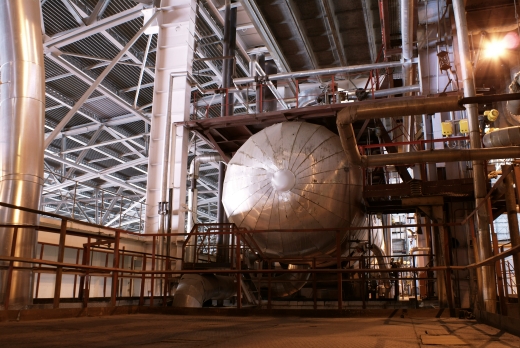

Radiometric detectors measure reliably and contactlessly through massive, thick-walled containers, regardless of high process temperatures and pressures.

Radiometric sensors deliver stable and reproducible measured values regardless of the ambient conditions – whether extreme temperatures, pressure fluctuations, steam, condensate or deposits – as there is no signal reflection or measurement field interference within the process.

High process safety, even in the presence of aggressive and toxic media
Particularly with highly aggressive, abrasive or toxic media, non-contact measurement – right through pipe or vessel walls and regardless of the medium – significantly increases safety for both personnel and the plant. Radiometric instrumentation delivers reliable readings even in processes with acids, solvents, or strongly alkaline slurries.

Simple installation and flexible retrofitting
Radiometric systems can be retrofitted into existing plants without the need for structural alterations and, in most cases, without interrupting the process. The detector and source holder, i.e. radiation shielding container, are mounted on the outside of pipes or vessels. Integration into existing control systems is achieved via analogue or digital interfaces. For this purpose, VEGA offers a comprehensive range of mounting accessories for all pipe diameters and vessels, as well as detailed support for planning and assistance with regulatory approvals.

What are the areas of application for radiometry?

Radiometric measurement is used wherever conventional measuring methods reach their physical, chemical or mechanical limits. The following typical applications clearly demonstrate why radiometric measurement is indispensable in many industries – whether to ensure occupational safety, process continuity or quality. While radiometry circumvents the limitations of conventional measuring techniques through a physically independent, externally acting principle, capacitive, hydrostatic, and optical sensors require contact with the medium and are susceptible to buildup, foaming and aggressive chemicals. In the presence of heavy vapours, high pressure and temperature fluctuations or unsuitable media, radar and ultrasonic sensors will also reach their limits.
VEGA Solitrac 31 uses radiometry to measure the level of lithium.

Limit level detection
In silos containing extremely dusty or sticky materials, radiometric limit level sensors reliably detect when critical levels are reached, for example to prevent overfilling or to trigger an automatic start-stop signal in conveying processes.

Level measurement
In large, pressurised or thermally insulated vessels – for example in the petrochemical industry or in power plants – radiometric level measurement is often the only practical solution. Detectors provide precise measurement data across the entire height of the vesse without opening the vessel or interrupting the process in any way.

 
VEGA MINITRAC 31 performing radiometric density measurement in a pipeline

Density measurement
Radiometric density measurement enables continuous monitoring of liquids or suspensions in pipelines, directly fin pipelines. Typical applications include concentration measurement, phase detection and quality assurance. By means of physical parameters, density measurement allows for targeted process control in reactors or mixing vessels.

Density profile measurement and interface detection
A density profile can be created by installing multiple detectors along the length of a vessel. This is particularly advantageous with multiphase media, as it enables reliable detection of interfaces between oil and water or sedimentation processes in settling tanks or separating columns.


Mass flow measurement
On conveyor belts or screw conveyors, radiometric instrumentation enables non-contact mass flow measurement – ideal for abrasive or hot materials like ore, cement, coal or recycled materials. While conventional weighing systems on belt conveyors are prone to malfunctions and require intensive maintenance, the radiometric solution operates independently of belt tension, load profile and environmental influences.

Reliable when the going gets really tough – radiometric technology is complementary to more conventional process measurement methods

Conventional measuring principles are efficient and cost-effective in many applications. Under extreme conditions, however, they quickly reach their limits. Radiometry is therefore not intended as a replacement, but as a highly specialised complement to industrial measurement technology.

It allows measurement at "unmeasurable" points and makes a significant contribution to process stability, productivity and occupational safety – whether the application involves level, density, limit level, interface or mass flow.

The completely non-contact operating principle, independence from extreme environmental conditions and high accuracy means that radiometry plays an important role in modern industrial measurement technology and is essential for operators of complex industrial plants.

Proceses that face extreme temperatures, aggressive media or complex installation scenarios, find radiometric measurement technology to be a robust, reliable and cost-effective long-term solution.


Related posts

Topics

Comments

Write a comment

Share this article

VEGA Australia Pty Ltd, 34 Cawarra Road, 2229 CARINGBAH, NSW
info.au@vega.com · 1800817135